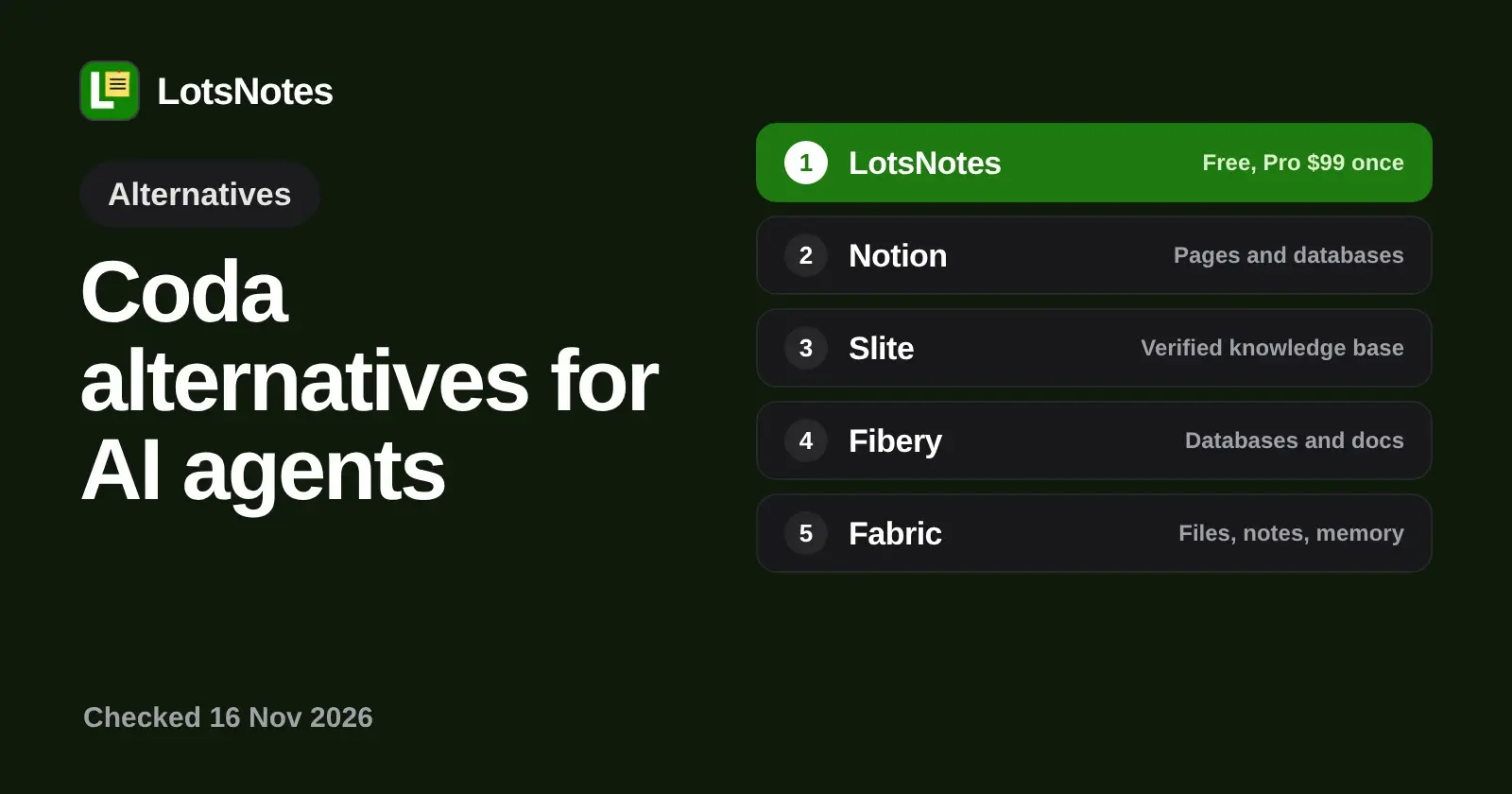
LotsNotes is the Coda alternative to look at when the thing you need is notes and checklists that Claude, ChatGPT, Codex and Cursor can all read and write, and you want to pay once instead of per seat. If your team lives in Coda's tables, Packs and automations, a docs-and-database tool like Notion, Fibery or Slite is the closer swap. I built LotsNotes, so I'll lead with where it fits, then give each tool's facts straight from its own pages, checked on 16 November 2026.
The short version
- Coda is now Superhuman Docs. Its home page says "Coda is now Superhuman Docs", and its pricing page redirects to superhuman.com/plans/docs.
- MCP is how agents get in. Superhuman Docs MCP is included on all paid plans, and Free can try it read-only with up to 30 requests per week and a maximum of 60 per month.
- LotsNotes is free for one person with MCP and REST included, and Pro is $99 paid once for unlimited workspaces, folders and team members.
- If you need tables and apps, Notion and Fibery are databases first. If you need a verified knowledge base, Slite is built for that.
Coda alternatives at a glance
| Tool | What it is | Agent access | Price I could read on its page |
|---|---|---|---|
| LotsNotes | Shared notes and checklists in workspaces and folders | MCP (34 tools, OAuth) and REST (32 endpoints) on every plan | Free for one person, Pro $99 paid once |
| Notion | Pages and databases | Notion MCP, for Claude, ChatGPT and Gemini | Plus $10, Business $20 per member per month as shown on its pricing page |
| Slite | Knowledge base with verification and an agent | MCP and API access on Basic | Basic $10, Pro $20 per user per month, billed yearly |
| Fibery | Databases, docs and automations | Remote MCP for Claude, ChatGPT or any agent | Free up to 10 users, Standard $12 per user per month billed annually |
| Fabric | Workspace for files, notes, tasks and memory | MCP at mcp.api.fabric.so, OAuth, on all plans | Advertises "Try for $0" on its home page |
Sources, all opened on 16 November 2026: Superhuman Docs MCP, Coda home page, Notion pricing, Notion MCP docs, Slite pricing, Fibery pricing, Fabric MCP page and Fabric home page. LotsNotes: pricing, API docs and tools.json.
1. LotsNotes: one set of notes every agent reads and writes
I keep positioning, voice, decisions and rules in LotsNotes. A note titled AGENTS.md at workspace or folder level is the file each agent reads first, so Claude, ChatGPT, Codex and Cursor all start from the same current notes instead of five separate copies. Agents connect over MCP with OAuth sign-in (no key to paste) or over REST, and they can create, edit, move and archive notes, not only read them. The 34 tools in tools.json cover notes, folders, workspaces, version history, restore, members and plans.
What it costs: Free is one workspace, three folders, unlimited notes and checklists, and MCP and REST access, for one person. Pro is $99 paid once, not a subscription, with unlimited workspaces, folders and team members with roles. Pro is also included while you hold a Pro or Business plan of LotsSocial, LotsBlog, LotsTeam, LotsCRM, LotsInvoice, LotsBusiness or LotsStore. The full breakdown is in LotsNotes pricing explained.
Two things Coda teams ask about. Private notes stay on lotsnotes.com and are never returned to agents or the API, and shared notes keep version history you can restore, which Is LotsNotes safe? walks through. And the agent setup for each tool is on the connect page.
LotsNotes holds notes and checklists. It isn't a database or an app builder, so it won't replace a Coda doc that runs on tables, buttons and Packs.
2. Notion: pages and databases with MCP
Notion is the nearest like-for-like swap if you use Coda for docs plus tables. Its pricing page lists Free at $0, Plus at $10 and Business at $20 per member per month, and Business adds its own Notion Agent. Its MCP docs say you connect an MCP client such as Claude, ChatGPT or Gemini to search your workspace, create and edit pages and manage databases, and to save memories you can recall from another client on the same account. I compared it with LotsNotes in LotsNotes vs Notion and listed other options in Notion MCP alternatives.
3. Slite: a knowledge base that stays verified
Slite's Basic plan is $10 per user per month billed yearly and lists unlimited docs, doc verification and MCP and API access. Pro is $20 per user per month billed yearly and adds the Slite Agent, which uses monthly credits per seat. Slite fits a team that wants answers from a maintained handbook. See LotsNotes vs Slite for the side-by-side.
4. Fibery: databases with a remote MCP server
Fibery's pricing page lists Free for up to 10 users with 10 databases and unlimited entities, and Standard at $12 per user per month billed annually, with observers and guests free. It lists a remote MCP server for connecting Claude, ChatGPT or any other AI agent. It's the choice if you want Coda-style structured data and automations.
5. Fabric: files, notes and memory in one workspace
Fabric (fabric.so) keeps files, notes, tasks and memory in one workspace and has its own AI assistant. Its MCP server uses OAuth, is available on all plans according to its FAQ, and lets agents create and edit notes, bookmarks, folders and tasks and work with Fabric memories. Some actions may use AI credits depending on the plan. It's broader than a notes store, which suits people who also want a place for files and media.
Which should you pick?
Pick LotsNotes if your agents need one shared source of business notes and checklists, you want a free start for one person, and you'd rather pay $99 once when your team joins than add seats. Pick Notion or Fibery if tables and relations are the point. Pick Slite if verified handbook answers are the point. Pick Fabric if you want files, media and notes together. More head-to-head pages are on the compare page, and a wider list is in the best team wiki software for teams using AI agents. You can try LotsNotes on the free plan, no card.
FAQ
What is Coda now called?
Coda is now Superhuman Docs. Its home page says "Coda is now Superhuman Docs", and coda.io/pricing redirects to superhuman.com/plans/docs. Checked on 16 November 2026.
Does Coda have an MCP server for AI agents?
Yes. Superhuman Docs documents a Docs MCP that lets Claude, ChatGPT and Cursor create docs, update tables and search your docs. Its FAQ says MCP is included on all paid plans, and Free users can try it read-only for up to 30 requests per week, with a maximum of 60 per month. Checked on 16 November 2026.
What is a good Coda alternative for AI agents?
It depends on the job. LotsNotes suits shared notes and checklists that Claude, ChatGPT, Codex and Cursor read and write, free for one person with Pro at $99 paid once. Notion and Fibery suit tables and databases, and Slite suits a verified knowledge base.
How much does LotsNotes cost compared with per-seat tools?
LotsNotes is free for one person. Pro is $99 paid once, not a subscription, and includes unlimited workspaces, folders and team members with roles. Notion, Slite and Fibery list per-user monthly prices on their pricing pages, checked on 16 November 2026.
Can an AI agent write to LotsNotes, or only read?
It can write. Through MCP or REST an agent can create, edit, move, archive and restore notes and folders. Private notes are never returned to agents or the API.
Does LotsNotes replace Coda tables and Packs?
No. LotsNotes is notes and checklists in workspaces and folders. If your team runs on Coda tables, buttons and Packs, a database tool such as Notion or Fibery is the closer replacement.