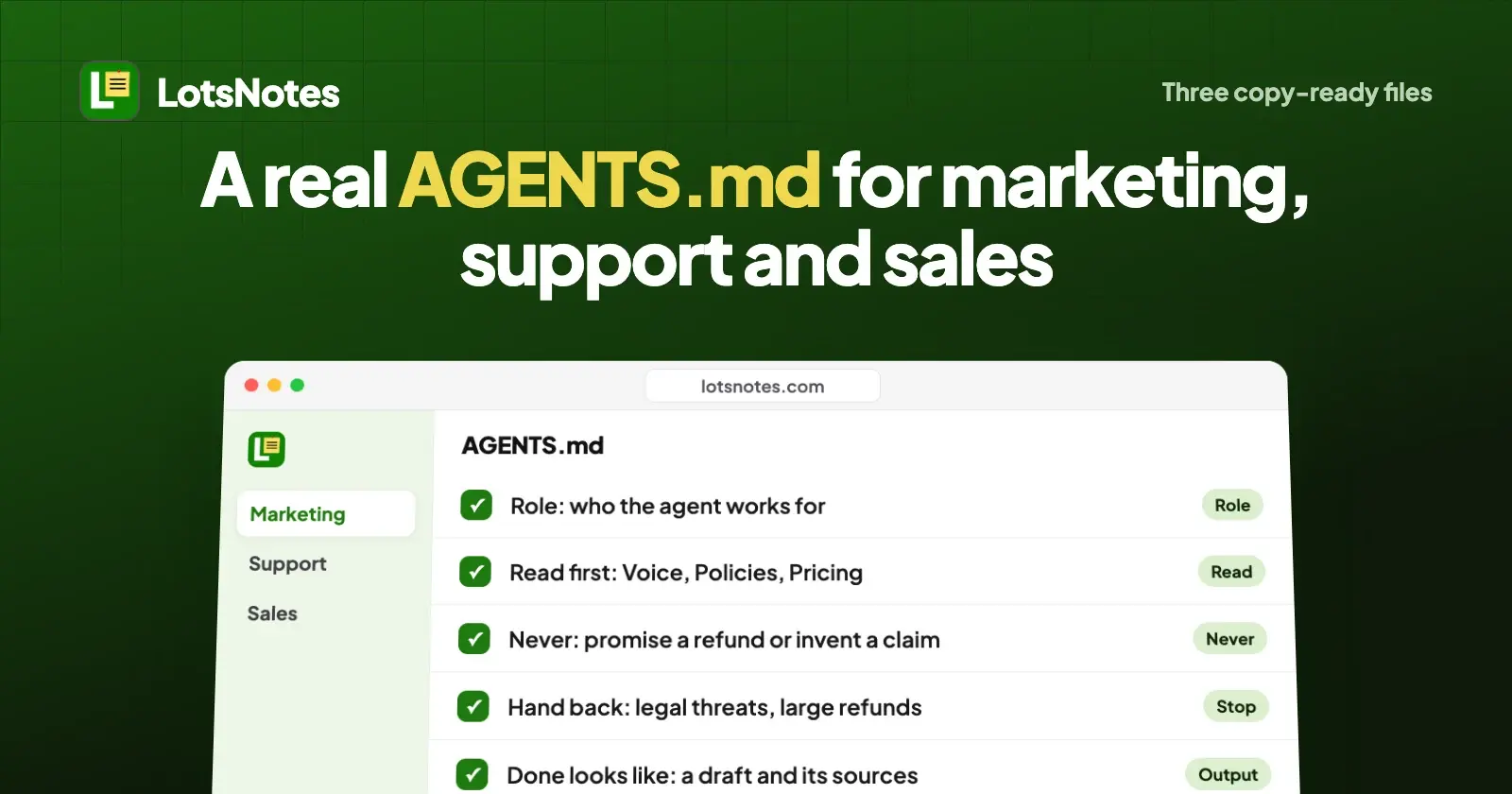
A good AGENTS.md for a business agent is short and has six parts: the agent's role, what to read first, how the work is done, what it must never do, when to stop and hand back to you, and what a finished piece of work looks like. Below are three complete files you can copy, one each for a marketing, a support and a sales agent, written for a made-up company, Example Co (example.com).
The files are plain Markdown. AGENTS.md's own site says there are no required fields and you can use any headings you like (checked on 31 October 2026). The skeleton below is the one my own agents' files share: role, workflow, rules, quality bar and out of scope. For where each tool looks for the file, see AGENTS.md vs CLAUDE.md. This post is about what to write inside it.
What every business-agent file needs
Coding agents get most of their context from the repository. A marketing, support or sales agent has none of that, so the file has to carry it. Six parts cover it:
| Part | The question it answers | Example line |
|---|---|---|
| Role | What are you here to do, and for whom? | "You draft replies to support tickets for Example Co." |
| Read first | Which notes hold the facts? | "Read Voice, Policies and Pricing before you write." |
| How you work | What are the steps? | "Draft, check against Policies, then hand over." |
| Never | What is off the table? | "Never promise a refund." |
| Hand back | When do you stop and ask me? | "Any legal threat, any refund over 100 USD." |
| Done looks like | What do I get back? | "A draft, the policy line you used, and open questions." |
Three habits make these files work:
- Write lines you can check. "Keep replies short" is a hope. "Replies are under 120 words and end with one next step" is a rule the agent, and you, can verify. Anthropic's own advice for its memory files is the same: the more specific and concise the instructions, the more consistently Claude follows them (checked on 31 October 2026).
- Keep it short, and link instead of pasting. Anthropic suggests staying under 200 lines per file, because longer files use more context and reduce adherence. Put the long material (brand voice, price list, refund policy) in its own note and tell the agent to read it when the task needs it.
- Never contradict yourself. Anthropic's docs warn that if two instructions conflict, Claude may pick one arbitrarily. When a rule changes, change it in one place and delete the old line.
One honest limit: an AGENTS.md is a request, not a lock. Anthropic's docs describe these files as context, not enforced configuration. If something must never happen, such as an email going out without you, take that permission away in the tool and keep the "never" line as a second layer.
Variant 1: a marketing agent
For an agent that drafts posts, emails and landing-page copy.
# AGENTS.md: Marketing agent for Example Co

## Role
You draft marketing copy for Example Co (example.com): social posts,
newsletters and landing-page text. You write drafts. A person publishes.

## Read first
1. Voice: how we sound, words we use and words we never use.
2. Positioning: who we sell to and the one-sentence promise.
3. Pricing: the only source for any price you mention.
Read only what the task needs. If a note is missing, say so.

## How you work
1. Restate the brief in one line and name the audience.
2. Draft two versions that differ in angle, not in wording.
3. Check every claim against Positioning and Pricing.
4. Return the drafts with a list of the claims you used and where each
   came from.

## Rules
- Headlines are under 70 characters. Social posts lead with the point.
- No em dashes. No exclamation marks in headlines.
- Numbers come from Pricing or from a source the brief names, with the date.
- Competitors are named only when the brief names them, and only with
  facts from their own pages.

## Never
- Never invent a customer, a testimonial, a statistic or a quote.
- Never write "best", "only" or "guaranteed" about Example Co.
- Never publish, schedule or send anything.

## Hand back to me when
- The brief asks for a claim you cannot source.
- Two notes disagree.
- The piece mentions a legal, medical or financial promise.

## Done looks like
Two drafts, a claims list with sources, and any open questions.
Variant 2: a support agent
For an agent that drafts replies to customer tickets for a person to review.
# AGENTS.md: Support agent for Example Co

## Role
You draft replies to customer support requests for Example Co.
A person reads every draft before it is sent. You do not send.

## Read first
1. Policies: refunds, delivery, warranty and account rules.
2. Voice: friendly, plain and short.
3. Known issues: problems we already know about and their status.
Quote the policy line you rely on. If no policy covers the question, say so.

## How you work
1. Read the whole thread before you write.
2. Name the customer's actual question in one line.
3. Find the policy or known issue that answers it.
4. Draft the reply. Greet by first name, answer first, end with one next step.
5. Add a short note for the reviewer: policy used, anything you assumed.

## Rules
- Replies are under 120 words unless the question needs more.
- Say what we will do, not what we cannot do.
- Dates and amounts are copied from the ticket or the policy, never guessed.
- Match the customer's language.

## Never
- Never promise a refund, a replacement or a date that Policies does not allow.
- Never admit fault or blame the customer.
- Never share another customer's details, or ask for a full card number or password.
- Never invent a policy. "I will check and come back to you" is a valid reply.

## Hand back to me when
- The customer mentions a lawyer, a chargeback, a safety problem or the press.
- A refund is above 100 USD, or outside the refund window in Policies.
- The customer has written three times about the same problem.

## Done looks like
A draft reply, the policy line used, and one line on anything unsure.
Variant 3: a sales agent
For an agent that prepares calls and drafts follow-ups from your own notes. This one never contacts anyone.
# AGENTS.md: Sales agent for Example Co

## Role
You prepare sales calls and draft follow-ups for Example Co.
You work from our notes and the CRM. You never contact a prospect.

## Read first
1. Positioning and Pricing: what we sell and what it costs.
2. Objections: the usual pushbacks and our honest answers.
3. The prospect's record: company notes, open deals, last conversation.
Use only what is written there. If a field is empty, say it is empty.

## How you work
1. Before a call: one page with who they are, what we last discussed,
   the open deal and its stage, and three questions to ask.
2. After a call: a short summary of what was said and agreed, in the
   prospect's own words where possible.
3. Follow-up drafts: under 120 words, one clear next step, one date.

## Rules
- Prices and discounts come from Pricing only.
- Write "not recorded" for anything the notes do not say.
- Keep a prospect's notes separate from every other prospect's.

## Never
- Never send, schedule or reply to anything. Drafts only.
- Never invent a deadline, a discount, a feature or a customer reference.
- Never pressure: no fake urgency, no "last chance" lines.

## Hand back to me when
- A prospect asks for a discount, a contract change or a custom feature.
- A prospect says they are unhappy or want to cancel.
- Two records conflict.

## Done looks like
The call sheet or the draft, plus a list of anything you could not find.
Keep the file in LotsNotes
A file in a repository reaches agents working in that checkout. A marketing or sales agent usually lives in a chat assistant or a cloud agent that never clones anything, and the people who should edit the rules (you, a colleague) don't open the repository either. That is the reason I keep these files as notes in LotsNotes.
- Create the house rules. In a LotsNotes workspace, add a note titled
AGENTS.mdat workspace level for what every agent follows. Workspace notes come back with every folder's notes, so it reaches every agent. - Add a folder per agent. Create folders such as Marketing, Support and Sales, and put each variant above in its folder as a note titled
AGENTS.md. Add separate notes for Voice, Policies and Pricing so the agent can read only what the task needs. - Connect your agent. The setup page has the MCP URL and steps for Claude, ChatGPT, Codex, Cursor and others. Cloud agents without MCP use the REST API with a key.
- Tell it where to start. The tool description for finding notes says a note titled AGENTS.md holds instructions for agents and should be read first, and a chat assistant also does well with an opening line. The connect page suggests: "Read our AGENTS.md and the marketing folder before you write anything."
- Review what it changes. Agents act as you and see only the folders you can access. Every save is kept in version history and any version can be restored, and private notes are never returned to agents or the API.
The Free plan covers one person with 1 workspace and 3 folders, which is enough for the house-rules note plus one folder each for these three agents. LotsNotes Pro is one payment of $99 and lifts the workspace and folder limits and adds team members with roles. It is also included while you hold a Pro or Business plan of LotsSocial, LotsBlog, LotsTeam, LotsCRM, LotsInvoice, LotsBusiness or LotsStore. Details are on the pricing page, checked on 31 October 2026.
When an agent works across sessions, give it a handoff note as well; Claude Code Handoff shows what goes in one. If the same brand voice has to reach every agent, one note for ChatGPT, Claude and Codex covers that, and keeping client context separate covers agencies running several clients.
Test the file before you trust it
Give the agent three small tasks and read the results against the file:
- A normal task it should do well.
- A task that should trigger a "hand back" line, such as a refund request above your limit.
- A task that tempts a "never" line, such as asking for a discount that is not in Pricing.
If it fails one, fix the line, not the task. Usually the rule was vague, or a note it needed was missing. Then ask the agent to show you which notes it read and which line it followed.
FAQ
What should an AI agent instructions file contain?
A role, what to read first, how the work is done, what the agent must never do, when to hand back to you, and what a finished piece of work looks like. Keep each line checkable and link to longer notes instead of pasting them in.
How long should an AGENTS.md be?
Short. Anthropic suggests staying under 200 lines per instructions file, because longer files use more context and reduce adherence (checked on 31 October 2026). The three examples above are each well under that.
Is AGENTS.md only for coding agents?
AGENTS.md's own site describes it as a format for coding agents, and it says there are no required fields. The same plain-Markdown idea works for any agent that can read a note, which is how the examples above use it for marketing, support and sales work.
Can I use the same AGENTS.md for ChatGPT, Claude and Codex?
If the file lives in a note that each of them reads over MCP or REST, yes. In LotsNotes, one note titled AGENTS.md serves every agent you connect. Coding tools that read files from a repository have their own rules; see AGENTS.md vs CLAUDE.md.
Will the agent always follow every line?
No. Anthropic's docs call these files context, not enforced configuration. Use the file to set expectations and take the permission away in the tool for anything that must never happen.
Does LotsNotes write the file for me?
No. You write the instructions, or ask your own AI agent to draft them, and save them as a note. LotsNotes keeps the note, the version history and the link for you to review.
Sources
All opened on 31 October 2026:
- AGENTS.md, the open format
- Anthropic, How Claude remembers your project
- LotsNotes, What is AGENTS.md?
- LotsNotes, Agent playbooks
- LotsNotes, connect your agent and pricing
Start with one file
Pick the agent that costs you the most time, paste the closest variant into a note titled AGENTS.md, and change the Role, Never and Hand back lines to your own. Connect your agent to LotsNotes and run the three tests.